23 July 2007

Shepherd field trip


In June, when the first American team was here, we did something very special with our girls. Inspired by my friend Nita DeBorde and Psalm 23, we visited a Mongolian herdsman, or shepherd, with his flock of 250 sheep and goats. The idea was to do some practical teaching about God as our shepherd by learning about the role of a real shepherd. Although Mongolia's livestock-to-people ratio is about 13 to 1, most of our girls are from the city and are not that familiar with countryside life.

Our herdsman was named Batchulan, and he was like a sweet old grandpa. He told the girls many things about his work, and they asked a lot of questions. A couple of them even got to practice herding his nearby flock. One of my favorite things that Batchulan said was that he knew every single one of the animals, even from behind them, so that if one was missing he would immediately know it. What a beautiful picture of how intimately God knows each one of us!

After Batchulan finished speaking, the Americans in the group briefly taught through Psalm 23, and then we ate lunch on the grass. It was a perfect day - sunny, but not too hot. The girls had a great time, and we all learned a lot about a shepherd's daily life. Thanks to Nita for inspiring something so valuable, even though you didn't realize it!

12 July 2007

Gig 'em and Sic 'em


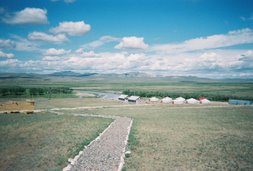
Is this a beautiful sight or what? Last week we had 3 American teams here: the Edwards praise team, Texas Baptist Men, and Baylor University. Nearly everyone from the teams claimed either Texas A&M or Baylor as its alma mater. We took the opportunity to do some group photos on our Hongor property. I also enjoyed seeing my Aggie flag raised on our flag pole! The girl in between the two flags did her undergrad at A&M and postgrad at Baylor (shoutout to Joel and Steven!). The buildings behind me in the last photo are dorm-type buildings where our staff and teams can stay in Hongor.

06 July 2007

Elders Banquet


I often describe our ministry here as including serving the needs of the poor and elderly in the community. A specific example is the annual elders banquet that we host for approximately 75 elders in the Darkhan area. Many of these men and women, the mothers and fathers of Mongolia, have few visitors and live in desperate conditions. We love honoring them with a meal and some live music provided by a team from America. They all get dressed up in their best attire, most of whom wear the traditional Mongolian "dell" outfit.

This year I was so blessed to attend the banquet, especially when I ran into a 72-year-old lady named Dolgorjav (pictured). Two years ago, I visited her home to deliver some food and check on her needs (also pictured). Our little team probably spent no more than 20 minutes in her one-room cardboard shack. Amazingly, when I saw her this week at the banquet, two years later, she remembered me. And because that visit made such an impact on me in 2005, I remembered her too.

All the elders at the banquet were so thrilled to be there, and several of the women left singing! What a privelege to serve those in need and be blessed in return.

01 July 2007

Mongolian beverages

In case you're interested to know what the average Mongolian eats and drinks, I thought I'd start out with the drinks. At most restaurants, you have your choice of various "multivitamin" juices (bottled mixed fruit juices), sodas (no diet!), water, beer, and hot teas. In the homes, people also drink raisin juice, milk tea (see recipe below), and airag (fermented mares' milk).

I'm not a big fan of milk tea, but I've learned to make it anyway because I host Mongolians in my apartment each week. They love it, and it's a very hospitable thing to serve. Personally, I love tea. But I learned to love tea in England, where I drank English breakfast tea with a little milk. Mongolian milk tea has basically the opposite tea and milk proportions, plus salt. (blech!) Try it for yourself!

Milk tea:
Bring the following to a boil on the stove: 1 liter water (about a quart), 1 Tablespoon loose black tea, 6-8 ounces milk (use 2% or more), pinch of salt to taste. When serving, pour through strainer to catch tea pieces. Serves about 10-15.

Note that in the countryside, some people will also add pan grease fat and other questionable items. I'd rather drink raisin juice!!

26 June 2007

Cold shower or no shower?

Mongolia has many proud traditions and several major holidays. Each year during July, Mongolians celebrate a 3-day festival called Naadam, where the "three manly sports" are exhibited: wrestling, archery and horseracing. I'm personally looking forward to it since I've never been in the country during Naadam before.

Currently I am "celebrating" a lesser known but significant 3-day annual tradition in June, the Mongolian hot water shutdown. Well, that's what I call it, anyway. Each summer the entire hot water supply in the city of Darkhan is completely shut off. I am told that this is so that maintenance can be performed on the pipes to clean out sediment buildup in order to be prepared for the winter. The cold water from the taps is frigid - and I'm not exaggerating - the toilet tank has a continual sweat on the outside because it's like ice water inside. So, taking a cold shower is like standing under ice water.

Faced with this predicament, you start to ask yourself questions like, "Is my hair really all that dirty? Surely no one will notice if I skip a couple days? How many pots do I have to boil water at the same time?" The first time I experienced this, I was a bit shocked. Now, I'm just somewhat amused. I fill up my big thermos with hot water and do the best sponge bath I can come up with. By Wednesday night at 8pm, when the hot water returns, all of Darkhan will be rejoicing in the shower.

Which option would you choose?

20 June 2007

Hongor village water update


The Hongor water situation is stabilized, for the time being. For the last two weeks, we've been providing clean drinking water to the people affected by the water contamination (see my previous blog posts). Twice a day, a large utility truck parks inside the village and allows everyone to come and draw water. I like going out there when I have time just to visit with folks. This boy told me that he is eleven years old. After some effort to mount his bike, he manages to pull that water canister behind him while riding his bike.

By God's providence, we had already planned for a small team from Baylor University to come and do some well work this summer. Later this month they will arrive and commence an effort to de-contaminate/purify the wells in Hongor. Our hope and prayer is that we can help get the wells fixed. Until then, however, we are committed to providing the daily water truck. Thanks so much to those of you who have made a contribution, it is truly preventing a toxic situation for many people, including this boy and his family.

13 June 2007

Chicken Gordon Blue

Ordering off restaurant menus in Mongolia requires the spiritual gift of discernment. Basically, you have to read between the lines and use your experience to predict what you're going to get. I've learned over time that what the menu says is not exactly what you'll get, but generally what you get tastes pretty good. So you just order in faith and it usually turns out fine.

Recently I had dinner at one of my favorite restaurants in Darkhan, called "Nice Cafe." Real original, right? One of the items on the menu was called "Chicken Gordon Blue." The short description read "chicken chest and cheese." It's difficult to find decent chicken, but I decided to try it. Turns out, it was disappointing. It consisted of two very thin, dry pieces of breaded chicken with a cheese slice melted in between them. And when I say cheese slice - think of the plastic-wrapped Kraft singles you buy in the grocery. The good thing is, food is so cheap that you don't feel too ripped off about a bad $3 meal.

I'm eating at home a fair amount, too. Choices at the food stores are slowly improving. This year's greatest news for me is that you can now buy SLICED BREAD at the grocery store! Up until this year, you either sliced your own bread or bought sliced bread in UB, the capital city (a 3 hour drive one-way). The funny thing is, I would bet the only people who buy the sliced bread are the foreigners. But isn't is strange that previously you could have your pick of the latest cell phones, but sliced bread was just too much of a luxury?!